Wednesday, June 17, 2009

The Software Development Cycle

With my recent contract now complete, I thought I'd post a few non-specific details about what I did during it. While it's not completely germane to Agile, you'll see a few places where there was some overlap, at least.

There were basically three parts to complete as part of the contract:
  • review the organization's current software development process
  • compare that picture to what a more standard development process would look like
  • provide recommendations on changes or enhancements that could be implemented to make things even better
Initially there had been some thought of doing a fourth part, as well: implement some of the recommendations, alongside the development team. However, virtually none of that came to be, through a combination of factors the most relevant of which was that the developers were in the middle of a high priority project that couldn't be delayed at the moment.

In order to get a clear idea of how development happened in this company, I read over a fair number of documents that related either to standards, or to recent projects, within the organization. From that exercise, along with a few strategically-timed interviews with personnel there, I was able to figure out what type of artifacts were produced, as well as which practices were followed. I'd describe what I saw as a fairly lightweight model, which is what I'd expected to find, given the age (fairly young), size (6 to 8 developers) and position within the company (an Information Technology group within an industry that's far removed from being an IT provider). In some areas, it was really only rigour that was missing; in others, there was simply a lack of experience with "best practices for large-scale software development", let's say. And that's the sort of thing you bring a consultant in for, anyway.

For the comparison aspect, my boss suggested a Gap Analysis in the form of a spreadsheet, which I thought was quite appropriate. The U.S. arm of the company had previously brought in-house a very comprehensive System Development Life Cycle model for the American IT groups (which are considerably larger than the Canadian one located here), and I was happy to use that as my baseline for the comparison. This model was very thorough (and very gated, as befits a Waterfall approach) and so it provided an excellent "ideal" for me to measure their setup against. There were roughly 150 artifacts or activities included in it, and so I was able to evaluate my clients' methodology in terms of which of those items they included, and (in a few cases, at least) how their versions measured up to the baseline.

Once the Gap Analysis was complete, I identified what I believed to be the highest priority gaps. This ended up being just over 20 items. For each, I then wrote up a Recommendation, in the following format:

Recommendation: xxx
Benefits: xxx
Approach: xxx
Effectiveness Metrics: xxx

In other words, I provided the what, the why, the how, and some notion of how to measure the results to make sure that they weren't wasting their time making the change.

That Gap Analysis spreadsheet, which included the 20-some Recommendations, was the primary deliverable from my contract. However, in talks with my boss we decided that a couple other concrete artifacts would be desirable to come out of this, as well. The first was a Microsoft Project Plan that was essentially a skeleton Plan that included all of the steps from the "ideal" SDLC model, customized somewhat to their environment, in order to make it easier for all of the steps to be remembered in the future. Also, because I considered a thorough and comprehensive Release Plan to be a prime example of where some additional rigour would help them out, I provided a template for that, too.

Those three documents were reviewed with most of the development staff on my last day there, and were extremely well-received. I had tried to incorporate as much feedback from the staff as I could in the content of my deliverables, and I think they appreciated that. One example was the inclusion of a recommendation that features be planned in a way that allowed them to be completed more serially than they had in the past, so as to allow at least some testing of some of the features before being passed on to the business area (who, in that environment, act as "QA"). That, and some of my unit testing suggestions, definitely benefited from my two years as Agile Manager!

All in all, it was a good learning opportunity for me, and I think that the clients received good value from my 22 years of IT experience. I think that if the timing had been different, such that the people there who needed to play a bigger part had had more time available, then it could have gone better and more immediate gains might have been realized. But as the poker enthusiasts say: you have to play the hand you're dealt, and that's what I did.

Sunday, June 7, 2009

Separating The How From The What

Poor AgileBoy!

One of the most common forms of "oppression" that I used to hear about in my role as Agile Manager involved Product people (or other representatives of management) going well beyond their mandate of providing "the "what" as they ventured into the thorny territory of "the how". I doubt that it was ever intended maliciously, no matter how much conspiratorial spice was attributed to it by the development team members... but if that's true, then why did it happen?

First, though, I suppose I should explain what I'm talking about. In most Agile methodologies, there's a principle that says that the Product Owner indicates what the team should work on - in the form of a prioritized Product Backlog - and the team itself figures out how best to deliver it. Thus, "the what" is the province of Product and "the how" is up to the team. It seems like a pretty sensible, straightforward arrangement, and yet it often goes off the rails. Why?

One cause for a blurring between the two can be Product people with technical backgrounds. We certainly had that in spades with our (aptly named) Technical Product Owners, most of whom were former "star coders" who had moved up through the programming ranks into management earlier in their careers. I'm sure it must have been very difficult for some of them to limit themselves to "the what" when they no doubt had all kinds of ideas - good or bad - about what form "the how" should take. In the most extreme cases, I suspect that there were times when our TPOs actually did have better ideas on how to implement certain features than the more junior team members did... but dictating "the how" still wasn't their job. In that sort of setup (where the Product area is made up of technical gurus), what would have been preferable would have been an arrangement where those TPOs could have coached the team members on design principles and architectural considerations in general, as part of the technical aspect of their title. That healthier response would have still accomplished what I assume was their goal - leading the team to better software choices - without overstepping their bounds and causing a schism between product and development.

Another factor that can result in people not responsible for "the how" trying to exert their influence on those who are, is a simple lack of trust. Again, I saw this in action many times as the Agile Manager. I'm not going to paint a black and white picture and pretend that it was always warranted, nor that it was never warranted. But the important point here is that dictating "the how" downward in that manner usually did more harm than good, and it certainly did nothing to close the trust gap. For one thing, having "the how" taken out of their hands gave those developers who were already skeptical about management's support of Agile more ammunition with which to say, "See? It's all just lip service! We're not really being empowered here!" It was also true, in some cases at least, that "the how" being supplied wasn't particularly well suited to the new development environment that was emerging. What with all of its automated tests, refactoring and focus on peer reviews, the code was resembling what "the old guard" remembered less and less with each passing Iteration. I experienced this first hand, as I'd make some small suggestion about how to tackle something that I thought might be helpful, only to get a condescending look and "Uh, it actually doesn't work like that anymore" from someone half my age. Yeah, that's tough on the ego, but it's also completely the right response.

As for why the trust gap was there in the first place, well... as both of my AgileMan books lay out in gory detail, lots of mistakes and missteps were being made. It wasn't exactly smooth sailing, let's say. The result of that, however, was that some among management apparently felt that the teams couldn't be trusted, and so they attempted to exert more and more control over them, in whatever ways they could. Had they simply applied that energy to improving the requirements gathering techniques being used within our organization, though, it would've benefited us more. Providing clear sets of Acceptance Criteria and good, well thought out constraints would certainly have done more to improve the product features that our teams were developing than any amount of "meddling" in the mechanics of the software development process itself ever did.

I imagine that it's often difficult to keep "the how" separated from "the what" as you work in an Agile environment, but it's critical that you do. After all, the people doing the work are in the best position to know how to do it, and that principle has helped make Toyota one of the premiere auto manufacturers in the world. We could do a lot worse than to follow their example in the Information Technology business!

Saturday, May 23, 2009

Agile Is In My Blood

It's striking to me how different my perspective is these days, as a result of my time as the Agile Manager at my previous job. I'm currently working in an environment that's not in the least Agile, and yet I still seem to perceive what's going on around me with Agile-Vision, as it were.

For example, I've spotted an instance where the separation between the business people and the development team has caused some issues, and so it seems fairly clear to me that that gap needs to be bridged somehow. It seems to me that there are lots of options available to be considered, even outside of an Agile methodology.

I can also see where delivering what's promising to be a fairly large feature set for the current project in smaller chunks will almost certainly help, even if the "delivery" here simply means working on the features in such a way as to allow the business folks to play around with them as they "come off the line". This won't be the Agile practice of working within short Iterations and having each small group of features "done done done", but at least it'll open up the possibility of getting feedback on many of the pieces before the development cycle is complete.

And finally, I've begun tossing around the idea of using something akin to a Retrospective for areas where the general consensus is that not enough is being learned or improved upon. That may apply to relationships between groups, or to preventing the same mistakes made in Phase N of the project from being repeated in Phase N+1. When I described what a Retrospective was to a few people, they seemed to like the idea ("like a Post Mortem, but focused on improving and learning instead of blaming and arguing"). So we'll see how that flies.

It's certainly odd to be back in a work environment that's so strangely different from what I was used to and yet still experiencing many of the same challenges. Go figure!

Saturday, May 9, 2009

A Horse Of A Different Colour


I'm venturing back into the work force on Monday, but with a twist. After 22 years of full-time employment, this will be my first experience as a contractor. Also, the work I'll be doing looks to be at least somewhat unlike anything I've ever done before.

I'll be performing a review of the development environment of a local company, in order to provide some guidance as they continue to refine their practices and processes. I think that I landed the contract on the strength of a couple factors in particular: my rather far-reaching involvement throughout my last employment as the Agile Manager, as well as the general breadth and depth of my resume, to date.

On that former point, it seemed relevant in the job interview that I had had some recent experience bringing change to an organization. I talked about how much I'd learned in the process, especially regarding the importance of being patient with people as they absorb information and evaluate it through their own personal filters. There's also naturally an element of trust required in something like that. I likened it to the expression about leading a horse to water but not being able to make it drink. My job often seemed to involve repeating that process, over and over again, until the horse finally trusted me enough (or maybe just got thirsty enough!) to take its first sip. (Not that I think of co-workers as horses! It's just an analogy!!)

By the same token, I think that the wide-ranging roles that I've performed over the past two decades also helped get me a foot in this particular door. I've worked on big mainframes and small client/server infrastructures; I've coded procedural algorithms (COBOL, C, Assembly language) as well as Object-Oriented solutions (C++, Java); I've been a "do-er" and a manager ("do-nothing-er"?); I've worked within well-understood roles but at other times had to define my own job. In fact, my resume, when I take the time to actually look at it (usually when I'm updating it), speaks volumes about the fact that I like new challenges. I've tended to change "jobs" (but not employers) at a pretty predictable rate of roughly every two years or so! And that's been true all along, showing that even as a wet-behind-the-ears programmer back in the 80s I was always looking for change as soon as I got comfortable with what I was doing. I think the pattern usually went: a few months of being a newbie, a year or maybe two of competence or better, and then on to the next thing. That cycle has given me a lot of varying experiences to draw on by now, it seems.

At any rate, I'll definitely be learning about a whole new set of parameters, starting next week. I'll be comparing what I see in front of me to my mental backlog of best practices. I'll be discovering what strengths and opportunities are in effect in an environment that's quite different than anywhere I've worked before, and making recommendations on each. And I'll be building up a bunch of new relationships, right from scratch. All of which sounds like something that should be right up my alley, I hope!

Sunday, May 3, 2009

No AgileMan At Agile 2009

I got the official word in the middle of last week that my proposed session for the Agile 2009 conference, "The Real-Life Adventures of AgileMan", didn't get accepted for inclusion in the program. In fact, of the 11 proposals that were made by people within my circle of friends (including my own), only one of them made the cut. Therefore either we're all very inept at writing up interesting session descriptions, or the competition was very fierce this year.

I don't know that my own efforts at "selling" my session idea were all that impressive, but I figured that I'd done OK. For the sake of posterity - and to let the readers of this blog judge for themselves - here's what I had written up:


Overview

What’s really involved in “going Agile”? While every Agile adoption has its own unique challenges and rewards, I’ve written 2 books about my company’s experiences moving from Waterfall to Agile. My focus is always on lessons learned, and we had literally dozens of those by the time we were done! In this session, I’ll be talking about early successes, what surprised us, where we dropped the ball, why role definitions turned out to be so important, where coaching would have helped, and many other similar topics. I think anyone considering a move to Agile would benefit from attending.

Process/Mechanics

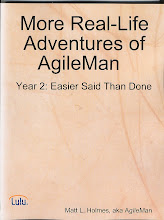
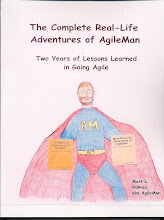
In the 2+ years that I spent as my company’s Agile Manager, I was involved with every aspect of our transition to an Agile methodology. I worked closely with the Project Managers, Development Teams, Product Owners, Information Technology and the company’s Executives over that span, and also had several stints as Agile Coach to some of the teams. I’ve written two books (“The Real-Life Adventures of AgileMan (Lessons Learned in Going Agile)” & “More Real-Life Adventures of AgileMan (Year 2: Easier Said Than Done)”) about our experiences, describing our lessons learned so that others might benefit from what we discovered.

Each of my AgileMan books contains 32 chapters, covering a range of topics related to Agile adoption, all told in a conversational tone from the perspective of someone who went through it all first hand. As reflected by the Learning Outcomes for this session, I always regarded our 2-year journey of “going Agile” as having a narrative thread to it. That perspective made it quite easy for me to transform what might have otherwise been fairly dry material into what ended up being a very entertaining series of stories (I’m told). The focus of the books is always firmly on what was learned, even to the point that each chapter ends with a Lessons Learned summary page recapping the key insights that were gained on each particular topic. I believe that the material would therefore lend itself quite naturally to a 90 minute (or longer) interactive PowerPoint presentation in which I recount the key experiences that we had, following the narrative flow from the books, and answer questions from the audience. I’ve done this same sort of thing for various university Computer Science classes here in Ontario and have had great results to date. Obviously the treatment would, by necessity, be somewhat different within an Agile-centric environment like Agile 2009, but I would imagine that anyone attending the conference because they’re considering a move to Agile would find such an in-depth experiential discussion invaluable.

For the conference, I plan to do the following:
  • introduce myself in terms of background
  • explain why I wrote the two AgileMan books
  • provide context for how the material in the books is organized
  • spend about 5 minutes on each of a range of topics from my books, including fielding questions from the audience
Although the final set of slides will depend on the session length, I would expect to cover many of the following topics, as I run through the chronology of our experiences and what we learned from them :
  • the pitfalls that may develop when Agile is mandated down from the top (rather than beginning as a grass roots movement)
  • some early signs of trouble (role confusion, under-staffing, shaky legacy code)
  • considerations around team composition
  • areas where management may send the wrong signals by only “talking the talk” without “walking the walk”
  • the challenges involved with promoting a cooperative (Agile) environment while still employing compensation systems that are essentially competitive
  • the pros and cons of co-location
  • what to look for in a good Agile Coach
  • where metrics can do more harm than good
  • the role of an Agile Champion
  • areas where teams may struggle with providing good estimates
  • what can happen when you consistently try to do more with less
  • the perils of redefining job titles when not everyone has bought into the new system
  • the problem of bug debt
  • what it may mean if your team members begin talking about “zone time”
  • what a team may look like when it’s sticking to its principles even in the face of opposition
  • how to build up trust within the organization, and what can happen if you don’t
I typically first describe the “story” aspect of the topic - what was going on in the workplace as it relates to that subject - and then provide a bullet-point list of the lessons that we learned. Tailoring the material to the length of the session (90 or 180 minutes, for example) is simply a matter of expanding or pruning it down to the appropriate number of topics, based on importance and target audience.

Learning Outcomes
  • Why we believed that Agile was the right solution to our problem
  • How we went about transitioning to Agile
  • What the early surprises were
  • Where Agile produced the biggest rewards initially
  • Which areas of the company struggled the most with Agile
  • How Agile was received and perceived by different parts of the company
  • What Agile can reveal about an organization’s culture
  • What roles proved the most difficult for us to get right
  • Where we needed help (and often didn’t seek it out)
  • What we might have done differently

While the e-mail notification that I received indicated that I could check my proposal for more feedback on it, there actually wasn't anything there to indicate why it wasn't accepted or what might have made it more attractive.

Oh well... I'm sure it would have been fun to do, and that any attendees in the audience who were either considering an Agile adoption or just starting down the path of one would have gotten a lot out of it. Heck, I wish someone had provided some of the insights that I intended to include in the session back in 2006 when I attended my first Agile conference!

Friday, April 24, 2009

Experimentation Takes Discipline


One of the key principles of any Agile methodology involves "inspecting and adapting." For those who are in the position of Agile Coach or Scrum Master, that sometimes gets represented in the mythical handbook as "encouraging experimentation." I personally think that it's one of the least understood and (perhaps accordingly) most poorly-applied Agile concepts, for a variety of reasons.

For most of us, success is almost always a goal. We want to do well at whatever we take on. And why not? Our performance reviews focus on how successful we were in various aspects of our job; our sense of self-worth is often dependent on how successful we believe others perceive us to be; and it just simply feels much better to "win" than to "lose." Unfortunately, though, experimentation brings with it the ever-present prospect of at least the appearance of failure, especially if one isn't careful about how one approaches such things. For example: if you take a bit of a gamble on something new in the course of your job (or personal life) and can see only two possible outcomes - it either works, or you're screwed! - then it's not hard to imagine that a "bad" result might make you less likely to ever again try something like that in the future. The problem could be that there was simply too much riding on the outcome to justify the risk in the first place, or that you didn't frame the experiment properly. For the latter case, a better setup would have been: "either this works and I have my solution, or I learn something valuable that gets me closer to finding the right answer." As long as learning and moving forward from your new position of greater enlightenment (what some short-sighted folks might indeed call "failure") is an option, then experimentation is a good avenue to go down.

What that implies, however, is that there's at least some degree of discipline involved. Randomly trying things until you find one that works, for example, isn't experimentation. What's required are some parameters that say, right from the start, what you're intending to learn from the experience. Determining whether your current architecture can support the new load that you're considering adding to it is an experiment that you might undertake, but ideally you'd like to get more than simply a "yes/no" answer from it. "Yes" is fine as an outcome (woohoo!), but you'd really like to elaborate on "no" with some results that provide insight into "why not?" and maybe even "where's the problem?" And therefore you'd design your implementation of the experiment with that in mind. Similarly, if you were on an Agile team and were going to try out pair programming as a possible practice, you'd want to establish a way of gathering results that provide you with lots of data. Subjective observations from those involved would be good, but so would some form of productivity measurement that would allow you to see - more objectively - whether pairing up team members causes the team's velocity to go up, down or stay about the same.

The final thought I have on this topic involves the notion of sticking with it long enough to actually get a result. That may sound obvious, but I've lost track of the number of times I've seen people start to try something new and then abandon it partway along. One way to avoid this is to establish, right at the outset, what the duration of the trial will be, as well as how the results will be gathered and measured. Among other things, that sets expectations and can prevent the impression of thrashing that might otherwise form in the minds of those who didn't realize that it was only an experiment in the first place. This could be a team trying something new and making sure that their Product Owner understood that it might "only" lead to learning, or a group of executives trying out a new organizational structure with the intention of re-assessing it after six months to see if it was working.

When I was asked at a recent speaking engagement whether I thought Agile was suitable for industries outside of software development, I mentioned that I thought scientific research, for example, had always been "very Agile." The very nature of good scientific work, after all, is to form a hypothesis and then conceive a test - or series of tests - to either prove or disprove it. The best scientists understand that sometimes you can learn more from a "failed experiment" than you can from one that gives you the results that you expected, and that that's a good thing. But that's only true if you're still paying attention by that point, rather than giving up or banging your head against the wall.

Wednesday, April 15, 2009

The Story Point Workshop


I've been meaning to write up a description of the Story Points Workshop that I designed and delivered in 2007 and 2008, but hadn't gotten around to it... until now. I figure that there's always a chance someone will stumble across this blog and be interested in getting some training on Story Points, and so I really should have something here by way of a sales pitch. If you're reading this and would like to know more, please contact me at AgileMan@sympatico.ca and we can discuss it further.

The workshop that I created is intended to be appropriate for anyone involved in the development of software: programmers, testers, integrators, project/program managers, product owners, team coaches and even executives. In other words, you have to possess at least a basic understanding of the process of software development in order to be able to complete the exercises. Note, however, that you don't have to be of a technical bent, as there's nothing in the workshop that requires you to design, program, or even debug any software.

My goal in providing the workshop has always been to increase the attendees' understanding of, and comfort with, Story Point estimates. At the end of the day, I want everyone who took part to feel confident that they can use Story Points themselves - either as producers of them, or consumers - as part of the release planning process.

To get a large group of people, often with disparate skills and perspectives, all the way to that goal, I use a format that's proven to be both effective and fun (based on the results of feedback surveys that I've done at the conclusion of each session). Basically, the day-long workshop goes as follows:

Part 1: Introduction of Story Points

Here I cover the concepts of relative sizing (as compared to absolute) and what Mike Cohn characterizes as "Estimate size; derive duration." I do this through a combination of slide presentation and interactive exercises, the latter of which allow the group to do some estimating on things not at all related to software (eg. figuratively moving piles of dirt). This 60- to 90-minute section ensures that everyone has a solid foundation of understanding around the conceptual portion of Story Points before we move on to applying that knowledge.

Part 2: Estimating in Story Points

For this part of the day, which takes up the majority of the workshop, I introduce a new application called "the Meal Planner." This is a Java program that I wrote years ago, but the attendees don't really see it or any of the code for it. Instead, what they see is a description of what it is, as well as a set of additional features for it. Because the Meal Planner is a simple and fun concept that anyone can grasp within a few minutes, it provides a perfect backdrop to use in understanding how to Story Point items. No one in attendance has any history with it, and therefore it's unlikely that anyone would dominate the proceedings based on any real or imagined "expertise" with it.

The attendees are then broken up into smaller groups of 5 to 7 people and physically separated (by team) as much as possible. Each team is tasked with coming up with Story Points for each of the items on the Meal Planner's product backlog. I serve as the Product Owner for each group, running back and forth between them in order to answer questions or offer clarifications to the requirements that they've been given. This exercise typically takes between two and three hours to complete, as the teams often get off to very slow starts while they go through the "forming/storming/norming/performing" cycle.

Part 3: Comparing the Results

When all of the teams have produced their Story Points for the complete set of backlog items, I bring everyone back together, post their results up on the walls and encourage each team to review what the others came up with. Then I have a representative from each team briefly go through their rationale for each estimate, allowing the other teams to comment or question them. Sometimes the teams will have arrived at similar estimates; often they'll be quite different. We discuss what sort of factors contributed to those results, and build up a list of "What Worked and What Didn't" that help the attendees understand what sort of things contribute to better estimating versus what works against that goal. I usually will also provide my own Story Point estimates (after everyone else has), based on having written the application. All told, this section usually requires about an hour to get through.

There's a slight variation on the above that I've done in one instance, which proved quite insightful for all involved. I had 2 groups in that case, and so I decided to spend most of my time with one, at the expense of the other. Also, I'd planned it so that the "AgileMan-starved" group got a different set of requirements than the other group, with slightly less details in it. The results of this disparity were striking, to say the least: in many cases, the "starved" team produced estimates that were completely at odds with what both the "better-fed" group came up with as well as the "expert's Story Points" that I provided. I think this sort of thing is probably only appropriate if the workshop is being set up for an environment where the product people are struggling to fulfill their responsibilities (as was the case where I did it).

It's possible to get all of the above done in as little as about four and a half hours, although that's awfully rushed and not very conducive to learning. I prefer to schedule it for either five or six hours, in order to allow for regular breaks and to give people the opportunity to reflect on developments as we go along. Something like a 9:30 start, with lunch brought in, and a wrap-up by 4:00, works best. I've done the workshop with as few as a dozen people, and as many as 25 attendees, and both extremes seem to work fine. With fewer than 10 to 12 people, it's difficult to get 2 groups that can compare results. More than 25 would provide quite a logistical challenge for me to facilitate once the smaller groups are formed.

When I took this workshop on the road to a company in the San Francisco area in late 2007, I did 3 sessions there (one per day) and received an average score of 8.7 (out of 10) in terms of "overall quality." One of the company's Vice-Presidents recently recommended me to a colleague based on those workshops, saying that I had "received the most positive reviews from folks that any trainer has at our site, and we've had quite a few." So I like to think that it left a good impression!